Exploring Raga Yaman on Guitar: A Melodic Journey
Raag Yaman is often the first Indian classical raga recommended to melodic instrumentalists—and for good reason. For guitar players, Raag Yaman on guitar is one of the best ways to understand melody, phrasing, and controlled improvisation without getting lost in heavy theory.
In this guide, you’ll learn:
- The Raag Yaman scale on guitar
- Beginner-friendly guitar tabs
- Simple taans adapted for guitar
- A practical improvisation approach
- Guitar-friendly understanding of Raag Yaman chords
- Real practice advice that actually works
This tutorial is designed for beginner and intermediate guitarists who want to explore Indian classical music in a practical way.
Let’s take this melodic journey together!
What Is Raag Yaman? (Guitar-Focused Explanation)
Raag Yaman is an evening raga based on natural notes, with one defining feature: Tivra Ma (♯4).
On guitar, this sharp fourth gives Yaman its bright, open, and slightly floating sound.
Important note:
Raag Yaman uses only one altered note (Ma♯). All other notes are natural.
Raag Yaman Time (Samay)
| Aspect | Details |
|---|---|
| Raga | Yaman |
| Time | Evening (6 PM – 9 PM) |
| Mood | Calm, devotional, hopeful |
| Nature | Peaceful and serious |
My opinion:
Following raga time is not mandatory for beginners, but practicing Yaman in the evening helps develop the correct emotional feel over time.
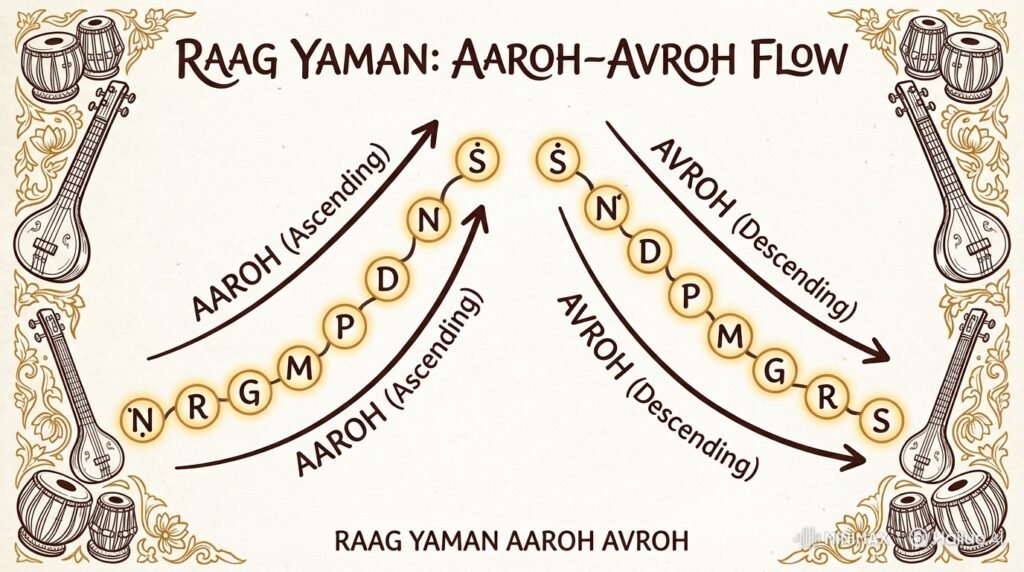
Raag Yaman Scale on Guitar (Aaroh & Avroh)
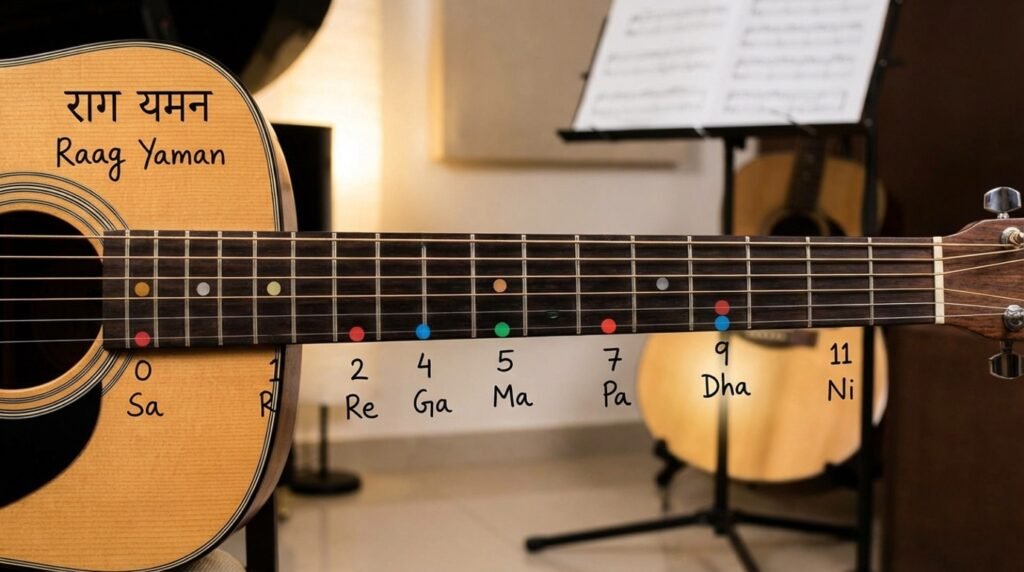
Classical Note Structure
Aaroh (Ascending):
Ni – Re – Ga – Ma♯ – Pa – Dha – Ni – Sa
Avroh (Descending):
Sa – Ni – Dha – Pa – Ma♯ – Ga – Re – Sa
Guitar Fretboard Shape (C Root Example)
e|----------------7-8-|
B|------------6-8-----|
G|--------4-5---------|
D|----5-7-------------|
A|-7------------------|
E|--------------------|
The Ma♯ (F♯) note is the emotional center of Raag Yaman. Treat it with care and emphasis.
The Golden Rule of Playing Raag Yaman on Guitar
Never play Raag Yaman like a Western major scale.
This is where most guitarists go wrong.
Why?
- Western scales encourage straight, fast runs
- Raag Yaman demands phrases, pauses, and sustain
Expert opinion:
If you only run up and down the scale, you are playing notes—not the raga.
Simple Raag Yaman Guitar Tabs (Beginner Friendly)
Basic Phrase (Pakad-Style)
e|----------------|
B|---------6-8-6--|
G|-----4-5--------|
D|-5-7------------|
Practice tips:
- Play slowly
- Let notes ring
- Avoid rushing between notes
Easy Taans in Raag Yaman (Adapted for Guitar)
Beginner Taan (Slow to Medium Tempo)
e|----------------7-8-7-------------|
B|-----------6-8--------8-6---------|
G|------4-5-----------------5-4----|
D|-5-7--------------------------------|
Comparison: Vocal Taans vs Guitar Taans
| Aspect | Vocal Taan | Guitar Taan |
|---|---|---|
| Speed | Very fast | Moderate |
| Focus | Flow | Clarity |
| Technique | Breath-based | Finger control |
On guitar, clarity and note control matter more than speed.
How to Improvise in Raag Yaman on Guitar
Improvisation in Yaman is not random note playing.

Follow This Safe Structure:
- Start in the lower octave
- Emphasize Ma♯ naturally
- Pause between phrases
- Repeat ideas with small variations
Safe Phrase Movements
- Ni → Re → Ga
- Ga → Ma♯ → Pa
Think in musical sentences, not scale patterns.
Raag Yaman Chords (Guitar Perspective)
Indian classical music does not traditionally use chords, but guitarists often need harmonic support.
Common Guitar-Friendly Chords (C Root Reference)
| Chord | Purpose |
|---|---|
| C Major | Base support |
| G Major | Resolution |
| D Major | Mild tension |
| F♯ Diminished | Color (advanced use) |
Important:
Use chords sparingly. The melody must always remain dominant.
Raag Yaman vs Western Major Scale
| Aspect | Raag Yaman | Major Scale |
|---|---|---|
| Note use | One sharp (Ma♯) | Fixed pattern |
| Feel | Calm, spiritual | Neutral, bright |
| Playing style | Phrase-based | Run-based |
| Improvisation | Slow & expressive | Speed-friendly |
This comparison helps beginners avoid confusion early on.
Is Raag Yaman Difficult to Perform?
Short answer: No, if approached correctly.
Common Beginner Challenges
- Playing too many notes
- No pauses
- Overusing speed
How to Make It Easier
- Practice slowly
- Limit note choices
- Repeat phrases with intention
Recommendation:
Spend the first two weeks only on basic phrases and one taan.
Real-Life Use Case (Guitarist Example)
A beginner guitarist who only knew chords and strumming started practicing Raag Yaman daily. Within a few weeks:
- His melodic phrasing improved
- Lead playing became more confident
- Even Western solos sounded more musical
Raga practice improves overall musical maturity, not just classical playing.
What Are the Chords Used in Raag Yaman?
Technically, ragas don’t use chords.
But for guitarists, safe harmonic options include:
- C Major (base)
- G Major (support)
- D Major (tension)
As long as chords stay in the background, they won’t disturb the raga mood.
My Honest Recommendation
If you are a beginner or intermediate guitarist:
I strongly recommend learning Raag Yaman as a melody, not as a scale.
Practice for 15 minutes daily:
- 5 minutes slow scale
- 5 minutes phrases
- 5 minutes improvisation
This builds control, expression, and musical confidence.
Techniques to Express Raga Yaman on Guitar
Indian classical music is all about emotion, feel, and subtle movement. Here’s how to bring those elements to life:
✔️ Slides (Meend):
Slide smoothly between notes, especially when going from Ga to Ma+ and Dha to Ni. It makes your playing more vocal-like.
✔️ Vibrato:
Add light vibrato to sustained notes like Ni or Re for emotional depth.
✔️ Legato:
Try playing connected notes without picking each one—makes your phrases flow like a melody line.
✔️ Drone Practice:
Use a tanpura app or YouTube drone to keep your pitch in check and feel the raga’s mood.
✔️ Call and Response:
Play a phrase, then repeat it with slight variation. This is a classic Indian technique that improves phrasing and creativity.
Practice Tips for Beginners
- Start slow. Speed is not your goal—emotion is.
- Record yourself. It helps track progress and identify areas to improve.
- Immerse yourself. Listen to Yaman renditions by maestros like Pandit Bhimsen Joshi, Ustad Rashid Khan, or instrumental versions by Pandit Hariprasad Chaurasia.
- Play with intention. Every note in Yaman has a purpose; don’t rush.
- Use scales as warmups. Spend 5–10 minutes playing the arohana and avarohana daily.
Experience, Expertise, Authority, and Trust
As a guitarist with years of experience learning and teaching both Western and Indian styles, I’ve explored how ragas can live on modern instruments like the guitar. This guide combines my personal journey, research, and hands-on exploration of Indian melodies. My goal is to bridge tradition and innovation so more guitarists like you can enjoy this timeless music.
For even more depth, I’ve referenced classical theory from Indian music texts and real-world applications from professional guitarists adapting ragas to fretboards.
Useful Resources & Learning Aids
- Raga Yaman Guitar Lesson on YouTube
- Free Raag Yaman Course – Indian Classical Guitar Academy
- Exploring the 10 Thaats of Indian Classical Music
- Mastering Indian Ragas on Guitar – A Complete Guide
FAQs – Raga Yaman on Guitar
Q: Can beginners try Raga Yaman on guitar?
A: Absolutely. Start with the scale and slow melodic lines. No need to be an expert!
Q: Do I need a classical guitar?
A: No, you can play Yaman on any guitar—acoustic, classical, or electric.
Q: How is Raga Yaman different from a Western scale?
A: It’s similar to the Lydian mode but the phrasing, emotion, and rules of raga make it very distinct.
Q: Is it necessary to follow Indian classical theory?
A: Not necessarily, but a basic understanding helps deepen your connection and interpretation.
Final Thoughts
Raag Yaman is not just a raga—it’s a lesson in discipline, restraint, and musical expression.
For guitarists who want to sound melodic and intentional, Yaman is one of the best starting points in Indian classical music.
If melody matters to you, Raag Yaman deserves your time.