
How to Build Smooth Strumming Without Breaking Rhythm
If your strumming sounds uneven, rushed, or breaks every time you change chords, you’re not alone. Most guitar beginners — and even many intermediate players — struggle with smooth strumming, especially when trying fast strumming patterns.
The good news? Smooth strumming is not about speed. It’s about control, timing, and one simple rule most players ignore.
In this guide, I’ll break down how to build smooth strumming without breaking rhythm, explain the golden rule of smooth strumming, and show you exactly what to practice so your rhythm feels musical, not mechanical.
What Does “Smooth Strumming” Actually Mean?
Smooth strumming doesn’t mean playing fast or fancy patterns.
Smooth strumming means:
- Your hand keeps moving evenly
- Your rhythm stays locked even during chord changes
- Your strumming feels predictable and musical
- Listeners can tap their foot without getting confused
If your hand freezes, jerks, or rushes — your strumming will never sound smooth, no matter how good your chords are.
Also Learn:-Essential Guitar Strumming Patterns for Beginners
The Golden Rule of Smooth Strumming (Most Important)
👉 Your strumming hand should never stop moving.
This is the golden rule of smooth strumming.
Even when you:
- Miss a string
- Play a muted stroke
- Skip a strum
- Change chords slowly
👉 Your hand must continue its down–up motion.
In my opinion, this single rule fixes 80% of strumming problems beginners face. People focus too much on hitting strings and forget about motion consistency.
Also Learn:- Strumming Pattern 101: Developing Rhythm and Timing
Why Guitarists Break Rhythm While Strumming
Let’s be honest — rhythm usually breaks for very specific reasons.
Common mistakes:
- Stopping the hand during chord changes
- Speeding up when the pattern gets tricky
- Using the whole arm instead of a relaxed wrist
- Thinking about chords more than rhythm
Smooth strumming fails when the brain panics and tells the hand to stop.
Smooth Strumming vs Fast Strumming (Big Difference)
Many beginners think:
“Once I strum fast, it’ll sound smooth.”
That’s wrong.
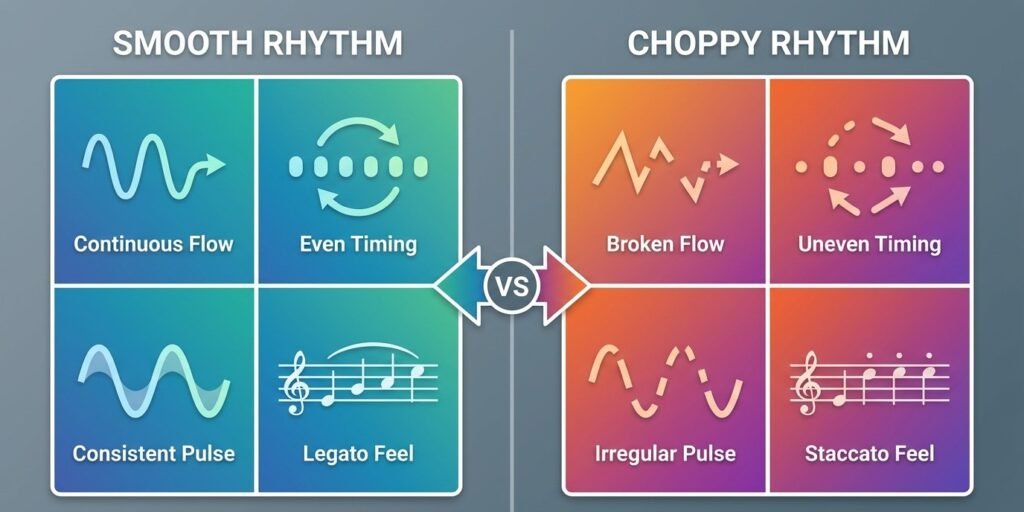
Comparison Table: Smooth vs Fast (Uncontrolled) Strumming
| Aspect | Smooth Strumming | Fast but Uncontrolled Strumming |
|---|---|---|
| Hand motion | Relaxed & continuous | Jerky & tense |
| Rhythm | Stable & predictable | Rushed or uneven |
| Sound | Musical & clean | Noisy or messy |
| Chord changes | Hidden naturally | Very obvious |
| Listener feel | Easy to groove | Hard to follow |
👉 Speed without control exposes mistakes. Smoothness hides them.
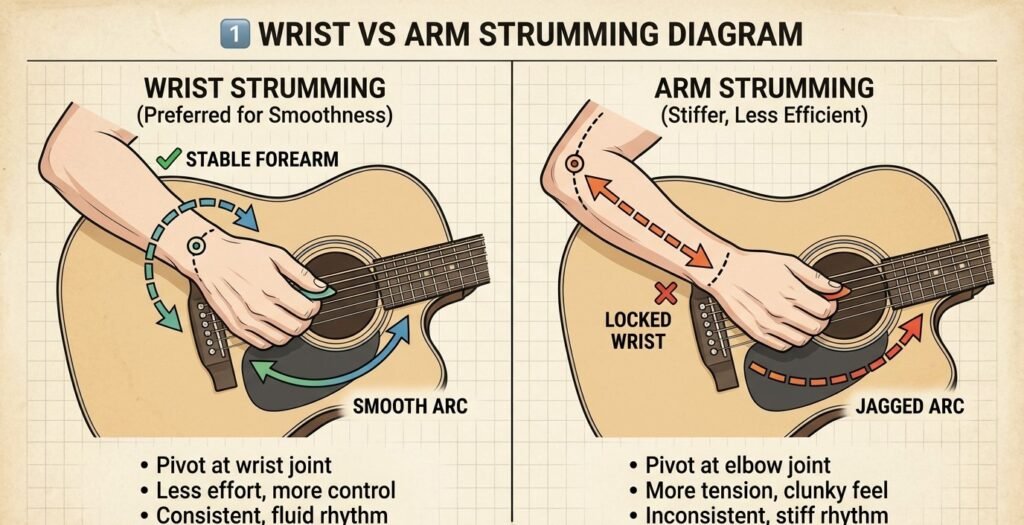
Wrist vs Arm: What Actually Works?
❌ Arm-dominated strumming:
- Tension builds quickly
- Timing goes off
- Hard to control dynamics
✅ Wrist-based strumming:
- Smaller motion
- Better timing control
- Easier to stay relaxed
Expert opinion:
If your shoulder feels tired, your strumming technique is wrong.
How to Practice Smooth Strumming (Step-by-Step)
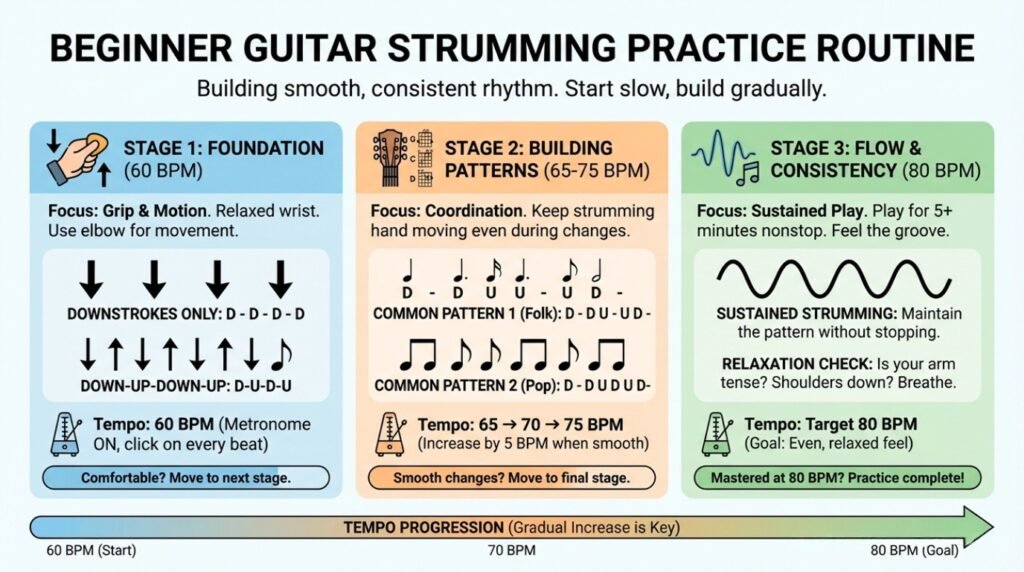
Step 1: Fix Your Hand Motion First
Before patterns, chords, or speed:
- Practice continuous down–up motion
- Even if strings are muted
- Even if you miss strokes
Step 2: Slow Tempo Is Non-Negotiable
Use a metronome:
- Start at 60 BPM
- Strum only down–up
- No fancy patterns yet
Smoothness is built slowly, not at performance speed.
The Best Exercise for Smooth Strumming (Beginner Friendly)
Exercise: Ghost Strumming
- Mute strings with your left hand
- Strum continuous down–up
- Accent only the downbeats
- Keep wrist loose
This trains:
- Rhythm stability
- Hand independence
- Muscle memory
I recommend this exercise to every beginner before learning songs.
Real-Life Use Case (Very Common)
One of my students could play all open chords perfectly, but every song sounded broken. The issue wasn’t chords — it was strumming.
We removed songs completely for one week.
Only:
- Muted strumming
- Slow tempo
- Continuous motion
After 7 days, his rhythm improved more than in the previous 2 months combined.
👉 Smooth strumming is a skill, not a side effect.
How Smooth Strumming Helps in Real Songs
Once your strumming is smooth:
- Chord changes feel easier
- Fast strumming feels natural
- Even mistakes sound musical
Songs like:
- Wonderwall
- Let Her Go
- Perfect (Ed Sheeran)
…sound 10× better with simple but smooth strumming.
My Honest Recommendation
If you ask me honestly:
I recommend focusing on smooth strumming first — not fast strumming.
Do this for 2 weeks:
- 10 minutes daily
- Metronome at slow tempo
- Wrist-based motion
- Ghost strumming + simple patterns
Speed will come automatically once rhythm is stable.
What to Practice Next
After smooth strumming improves:
- Accent patterns
- Dynamics (soft vs loud)
- Strumming sync with singing
Never jump to speed before control.
Final Thoughts
Smooth strumming is what makes a guitarist sound musical, even with basic chords.
If your rhythm is solid, everything else becomes easier — fast strumming, songs, even fingerstyle later.
Control first. Speed later.
That’s the real secret.